What are the primary functions of the WPM-FCCM-51 Automatic Flat Cable Machine?
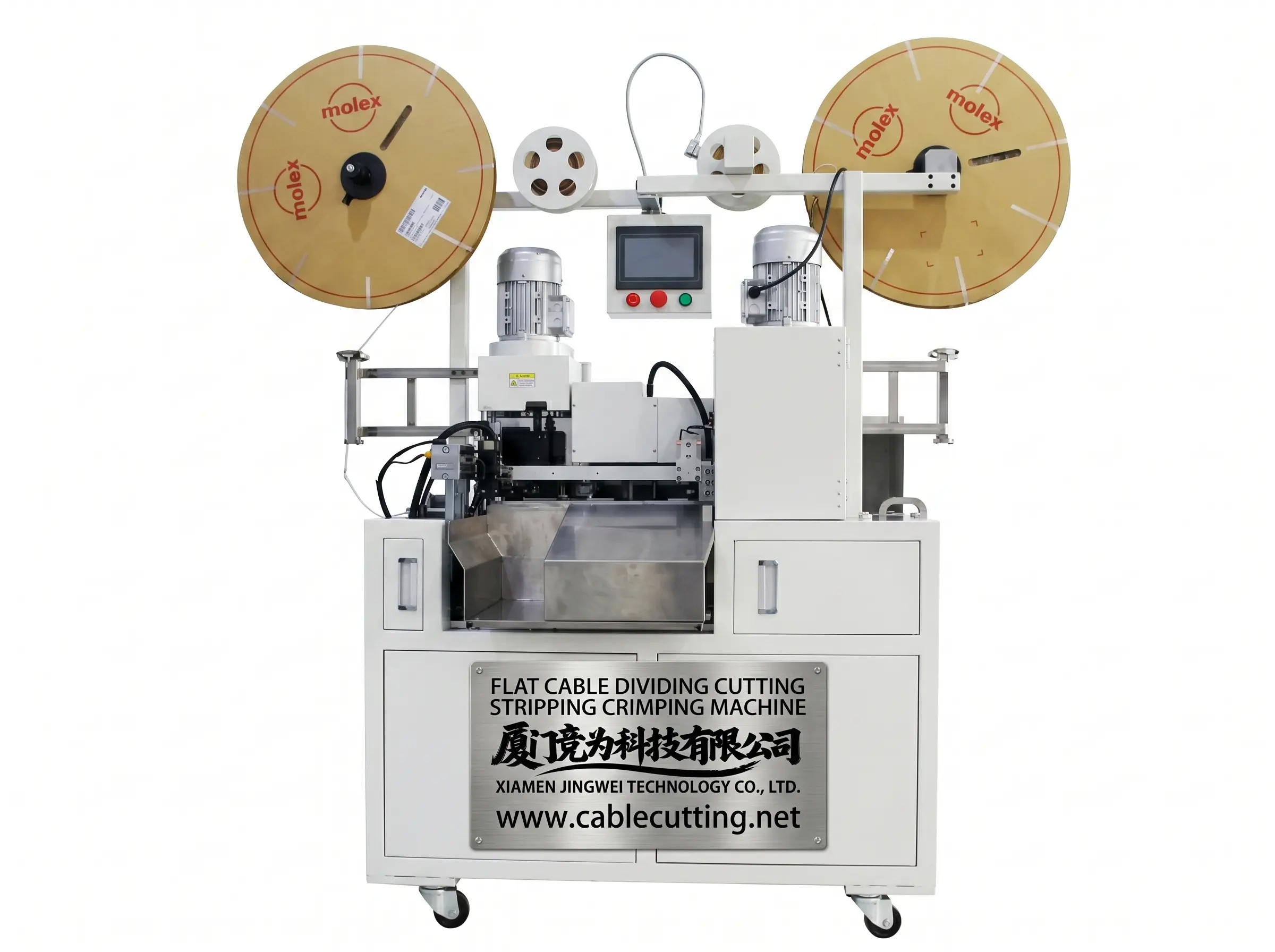
The WPM-FCCM-51 is a fully integrated wire processing solution designed to perform four key operations automatically: dividing flat cable into individual wires, cutting them to length, stripping insulation from the ends, and crimping terminals or ferrules. This high-precision automation streamlines the production of cable harnesses, eliminating multiple manual steps.
What is the production capacity and wire handling capability of this machine?
This machine is engineered for high-volume industrial production, offering a maximum output of up to 18,000 pieces per hour (PCS/H). It is specifically designed to handle flat cables with up to 20 positions (20P), making it ideal for processing multi-conductor ribbon cables commonly used in electronics, automotive, and appliance harness manufacturing.
What type of control system does the machine use, and what are the benefits?
The WPM-FCCM-51 utilizes a servo motor control system. This provides exceptional precision in wire feeding, cutting, and stripping lengths, ensuring consistent and high-quality results. Servo control also allows for quick and easy changeovers between different job settings via a digital interface, reducing downtime and increasing overall equipment efficiency (OEE).
For which industries and applications is this crimping machine most suitable?
This automatic terminal crimper is ideal for any industry involved in medium to high-volume wire harness assembly. Key applications include automotive wiring, appliance control panels, industrial machinery controls, consumer electronics, and data/telecom cable assemblies. It is particularly beneficial for manufacturers seeking to improve consistency, reduce labor costs, and scale their wire processing operations.
What are the main advantages of using an automatic machine like the WPM-FCCM-51 over manual processes?
Automating the dividing, cutting, stripping, and crimping process with the WPM-FCCM-51 offers significant advantages: dramatically increased production speed and throughput, superior and repeatable precision for reliable electrical connections, reduced material waste, and lower long-term labor costs. It minimizes human error and operator fatigue, leading to more consistent harness quality and improved workplace safety.
 English
 Chinese
 Russian
 French
 Spanish
 Arabic
 German
 Dutch
Dutch Portuguese
 Italian
 Turkish
 Korean
 Japanese
 Thai
Thai Czech
Czech Traditional Chinese
 Indonesian
 Vietnamese
 Hungarian
 Malay
Malay Swedish
 Finnish
 Danish
 Norwegian
 Polish
 Greek
Greek